Just got it from Drive Thru. Compelling, well-researched, can't put it down. Get this.

Boldvay's Fantastic Wargames Campaigns- Living Gaming Campaigns from Western Massachusetts, Playable Anywhere
Just got it from Drive Thru. Compelling, well-researched, can't put it down. Get this.
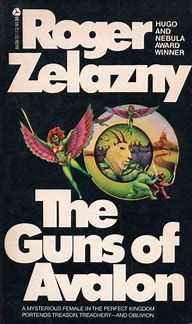
Roger Zelazny- The Guns of Avalon 1972
The second installment in Zelazny’s Amber series continues to shine as just purely great reading of fast paced, epic fantasy story telling that leads the reader along this great vivid journey but is lacking of overly descriptive and detail oriented prose so that you the reader have plenty of room to construct your own imagery to the tale. It picks up right where the first novel left off with the prince Corwin having escaped capture and the regrowth of his vision and a new plan to usurp the throne of his brother Eric who currently rules Amber. There is so much great D&D related material in this book, the continuation of the use of the cards as a means of psychic communication, and in this book outright psionic combat. There clearly has to be a relationship to psionics in the game and what happens in this novel and it’s just very inspiring to read and take in as this book was written in ‘72, and D&D comes out in ‘74- just a great book to immerse yourself in that early 70s gaming culture. In addition to psionics being drawn directly from this book we also see the manticore and wyvern making an appearance in the book, both present themselves as quite fearsome opponents. I’m not going to claim to be such a fantasy historian as to claim that this is the first time either/both creatures appear in literature, but again you can clearly see the connection to the Appendix N lit to the elements of the game. Probably one thing I got out of the book, and the series altogether is the Amber series is a perfect example of faction play- each prince representing a different bent or alignment, some more good, some more evil, all with different desires and goals, and all mingling in a brew of alliances and rivalries. It really is exactly how the rules set you up to play if you really dig into how the game was intended to be played. It’s a literal guide or example of how players should be interacting with each other especially at higher levels. The princes set up alliances which lead to battles over resources delineated on a map, it really is just a fantastic wargames campaign set to the novel format. Without belaboring the point the Amber series is just clutch reading, I’m amazed the further I get into this series. I’m a little embarrassed it took me this long to truly discover Amber, but now that I’m here I’m 100% along for the ride. Top notch pulpy epic fantasy with a twist of 60’s humor. It doesn’t take itself too seriously, but there’s plenty of meat in the story to keep you thinking about it. I look forward to book 3.
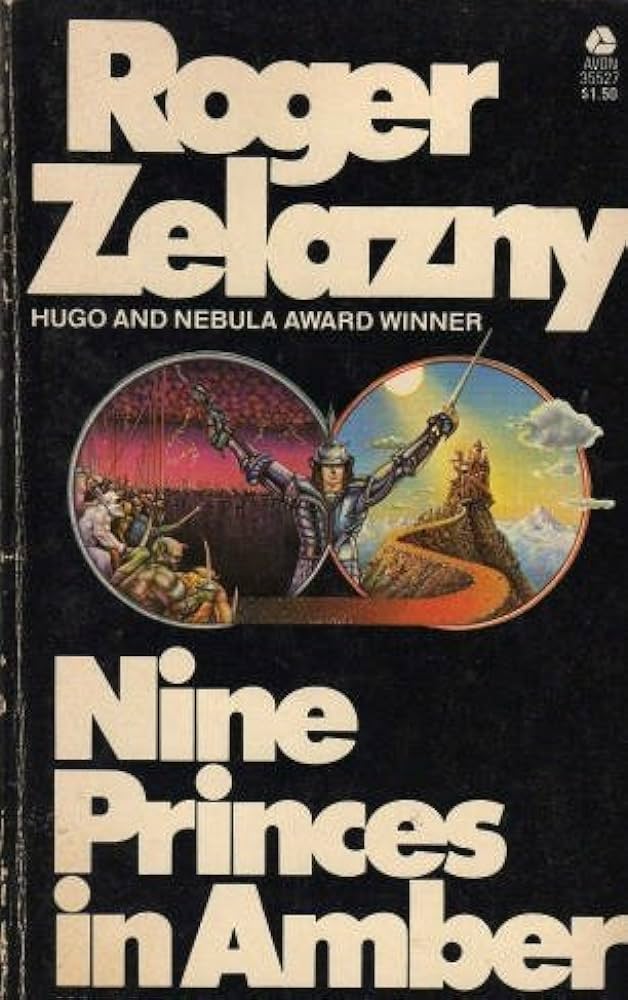
Roger Zelazny- Nine Princes in Amber 1970
This was my first time reading Zelazny, and this proved to be every bit of the essential classic that it is oft referred to as. This would be up there with Jack Vance as far as formative Appendix N literature. It introduces Corwin, and the city of Amber which is the setting and the main desire of Corwin and the other Princes who vie for control and make and break alliances in an attempt to gain control over Amber. As stated I have not read any of the series before, so I am along for the ride as far as the big picture of the whole Amber series, but this first book is an easy quick read that really gets the series going and still maintains the qualities of a self contained story. It begins with Corwin awakening on our Earth circa late 60s from an accident. He cannot remember his princely heritage nor Amber, but he begins to reacquaint himself with his true nature and meets one of his fellow prince brothers. They navigate the magical pathway back to Amber and find out the state of the other princes and their power struggles. The crafty brother Eric has become leader of Amber, and Crowin assembles allies and a massive army to confront him. There is a lack of heavy description in the battles and progression of the war that keeps the plot to a feverish pace and leaves the imagery up to the reader. The description of the magical Shadow, which one must pass through to reach Amber was vivid and eerie, as were the magical Trump cards, one with an image of each prince, that allows communication and teleportation among the princes. These concepts clearly had a lot of impact on some of the fantastical elements of D&D. I am excited to see how the remainder of this series plays out, it has a great sort of 70s vibe to it. There’s some lingo from that era embedded, and some social commentary of the period, for example Zelazny references radio DJs and their ability to enrapture teens in comparison to a magical effect that occurs in the story. I also noticed and appreciated how fantasy of that era was more apt to connect the fantasy story and characters to the real world. Much like early stories like Lost Horizons, there's a connection. The characters in the fantasy world come from our real known world, and you can actually get to the fantasy world from our world. Maybe authors of earlier fiction felt a stronger sense to connect their characters to the real world for empathy to the reader, whereas now authors and readers are more willing to just immerse themselves in a separate fantasy world. I‘m not sure if there’s any significance there, I do remember however that some of those early D&D games also had that concept, that the PCs were the actual players and the stats of those PCs were an approximation of the users personal stats and they were playing as if they personally were transported to a fantasy realm. Certainly a cool concept and one that could be explored again at one's own gaming table. In summation, I’m definitely late to the game on this one, Zelazny is one of the few Appendix N authors I never really investigated despite being a longtime fan of pulpy sword and sorcery fiction. Perhaps I just never made it to Z at the used bookstore, but I am definitely thankful to have begun reading him later in life. I look forward to the remainder of the series.
Harry Harrison- Planet of the Damned 1962
With Harry Harrison’s Planet of the Damned we have the first review of a book not mentioned in Appendix N, but representing the “+” in this series- basically Appendix N adjacent material I’m researching and reading. This is pulpy sci-fi, no fantasy influence here, but I’m very interested in this book because it’s connected to a side project I’m working on- an Escape From New York inspired Braunstein RPG. I’ve always been a huge EFNY fan, and in researching my game idea I found out that this book was a big inspiration for the film. In the book, a heroic winner of a planet wide greatest warrior competition is dispatched to a primitive and dangerous planet that has been accused of having weapons of mass destruction capable of destroying a nearby inhabited planet. He and his crack team of experts have mere days to navigate the dangerous new world, infiltrate its strange peoples and find out if in fact they do have the weapon and if so neutralize it before the planet is bombed to oblivion from orbit. I have not read any Harrison before, I have heard good things about his Stainless Steel Rat series, but this is my first reading, and i must say he pulls off some things that in this day and age may seem tropey and overused, but as this was written in 1962, was probably seen more as an upping in the intensity and tension in pulp sci-fi. The classic “timed mission” that will end in some kind of doomsday event is a theme explored in other genres such as war and action/adventure, andHarrison does it well. The pressure of the short time of the mission, fighting fatigue but needing sleep, and a few tics in the story that shorten the already feverish pace of the story work well and don’t feel hokey. Also, Harrison does a thing seen often in more modern stories- introduce a strong heroic character, then kill off said character early in the story as a way of disjointing the reader, and conveying an extreme sense of danger in their story. Our protagonist is originally the subordinate of this character, the one in charge, the one with the plan, and with his death happening in the first few minutes of landing on the planet, Harrison excellently and concisely brings the reader into the seriousness of the situation. There are some cool sneaky/ infiltration scenes in the book, some great action/ fight scenes, and a great frenetic pace. The chapter lengths are perfect, each a bite sized capsule that leaves you wanting to read the next, and some great descriptions of the desolate Road Warrior like planet and its dangerous hearty people. A great fun ride that at the time likely pushed the envelope on edginess. Must read for EFNY fans, you can definitely see things that influenced John Carpenter.
A. Merritt- Dwellers in the Mirage 1932
Again, my opinion remains very humble, but from my perspective A. Merritt is one of the lesser revered masters of the genre. Don’t sleep on this one, it’s an absolute classic. In it we see the common pulp trope of the powerful western European hero in a strange land as the the protagonist, Leif Langdon, is a massive blonde guy with Scandinavian roots who impresses all with his mere size and power. This guy has no kind of Campbell hero arc, he’s an accomplished hero before we even meet him, and this story does a good job of depicting a heroic journey of his descent into the strange world setting of the story. Where as in Poul Anderson’s Three Hearts and Three Lions, the hero is mystically and instantaneously transported to the magic realm from his home world in the midst of a WWII battle with little explanation, and we get right into the fantasy action, Merritt is much more descriptive in showing Leif and his companions journey down a deep endless valley into the fantasy world of Dwellers. It has much more of a Lost Horizons vibe, like the real world and this fantastic one are really connected through actual geography, only knowledge of the route bars entrance to the fantasy world. What starts out as kind of an Alaskan pioneer adventure story slowly transforms into pure fantasy dripping with sword and sorcery. He also does an excellent job of connecting real history to his pulp story, using the Uighar people as the culture that has a mystical connection to the hidden world. The key to the story is that our hero is mystically destined to bear a magic ring that summons an all powerful and horrible creature. In Leif's first interaction with the magic summoning he is unaware of what is actually occurring, and what he is responsible for, but by the end of the novel he is faced with a classic moral dilemma typical of many great stories, pulps and otherwise. In its connection to AD&D, I see lots of inspiration by way of how summoning is handled, as well as the type of imagery that goes along with massive ancient underground temples that hold the means to summon terrible creatures, and the kind of thoughts and inspiration that went into books like Deities and Demigods. Also in Dwellers, we see a well developed example of a classic pulp trope- the mystical race of humanoids that are caretakers or gatekeepers to the fantasy world. The heroes interact with a race of very small humanoids who are caretakers of the valley and guardians of the summoning ritual. The creature itself- the great Khal’Kru is somewhat Cthulhu-like, and came a few years after the Lovecraft story, but has its own personality/flavor, and commands a great presence in the novel, both in visions and when it is actually summoned. Dwellers in the Mirage is must read, and I’m told his other work Ship of Ishtar is equally essential Appendix N reading.
Appendix N+ Book Reviews
I thought that since I’m hoping to make the Nappendixia Campaign very much in the spirit and image of all the great literature of Appendix N, that a series of book reviews of recently read Appendix N and adjacent materials describing my impressions on the books I’ve read read would be an appropriate way to communicate this both on my blog and on the campaign’s Discord server. I’ll be giving my impressions of where I see the N source materials inform the AD&D 1e rules, and try to give insight as to where and what Appendix N material is inspiring my own (our own) campaign world. There is so much great Appendix N material out there, and I do not claim to have read it all, nor do I claim to be highly knowledgeable of all areas and authors of Appendix N. My foundation authors, the ones I read heavily as a kid and a young adult are Robert E. Howard, H.P. Lovecraft, and Michael Moorcock. For whatever reasons, these were the ones I found most interesting, were most discussed and recommended by friends, and were somewhat findable in either used book stores or mall bookstores of the time. I have since come to acquire quite a robust Appendix N collection, and am making my way through it energetically, but there is much I have not read. I have read very little Fritz Leiber, and have only just recently read Poul Anderson’s Three Hearts and Three Lions, so these reviews will not be me espousing my great literary knowledge on the topic, but more a document of my personal exploration into the body of works. Just sort of framing ahead of time what kind of reviews I’m aiming for, and what my background knowledge is.
Jack Vance- Dying Earth series, books The Dying Earth 1951, and Eyes of the Overworld 1966
The basics- The Dying Earth series is an amazing collection of tales of wizards (and thieves) making their way through a world both whimsical and strange and having remnants of an older more advanced sci-fi type culture that has mostly died out but has left a few odd remnants about. It is an amazing portrait of mad wizards ruling chaotic city states and using magic to harass and compete with other wizards and characters in the world. I’m definitely sorry that I discovered Jack Vance later in life, because I think so far more than any other Appendix N author, once you know Jack Vance you start to look at AD&D through different eyes. It really seems to be a heavy inspiration to so much of early D&D especially the magic side of the game. A lot of this stuff is elementary to Appendix N people, but I’ll be clear so anyone just getting into it can hear and understand. D&D magic is Vancian magic, it’s all spelled out in his books, beset by three basic principles that not all other literary worlds that have magic abide by. In Vancian magic, and in D&D magic, all spells are consistent recipes, wizards cannot just produce random or spontaneous projections of magic. Magic missile is a spell, it behaves the same no matter what wizard casts it, it is a universally known spell recipe in the world. In Vance he describes in several places how there are only so many spells in the Dying Earth world. He says that there used to be more but many were lost over time, and spells are highly coveted by wizards and rarely shared and always for a price. In Vancian magic spells also must be memorized or prepared ahead of time, and when cast they leave the casters memory until the time can be spent to rememorize. And finally the power of wizards is finite, you can only memorize so many spells, and weaker wizards can memorize fewer spells until they can increase their power, exactly mirroring how things work in D&D. Also what great to see in these Jack Vance stories is what does a world look like where the major power players are all wizards? In the AD&D rules, only clerics, fighters, and wizards can fully access the stronghold rules and rule domains. More often fantasy worlds and game worlds envision domains run mostly or entirely by high level fighters, with armies, castles and patrols being the means of domain management, but I think it much more likely that left to its own devices, a fantasy world would evolve as powerful wizards being the top dogs and using high level spells to take out their non-magical competition and the world devolves into wizard oligarchs moving the worlds chess pieces magically via their wizard towers. It’s quite a cool and unique world, and one that as I read just continued to blow me away with creativity and ideas. I keep a “Vance ideas list” as I read his stuff and write down little snippets of ideas I get while reading Dying Earth. Pacing wise, some of the stories meander, unlike most pulp which is terse and fast paced. I don’t dislike the pacing, but I did take a break from reading the last 2 books in the series just because there are so many books and authors I want to explore. I have the 4 book series bound together. It has a space station on the cover, so it's a little deceptive. Other than mentions of the old high tech world, this series reads like old fantasy. Just another of many many examples of modern printings of Appendix N books that just totally get it wrong in terms of cover art. When collecting Appendix N always look for used printings from the 80’s and earlier, the artwork is so much better. Anyway, this is must read, I’d put it at the absolute top of Appendix N must read, (albeit from someone who hasn’t read everything, yet)
Robert E. Howard- Sowers of the Thunder 1932-1933
I’ve read a lot of Howard’s Conan and Kull stories, and a bit of his spear and fang stories, but this is my first look at Howard historical fiction, and it’s glorious. It’s the same great Howard prose- direct, sparse in adjectives yet vividly descriptive, but applied to new characters set in an ancient historical setting. Several of the stories are set in the fictional mideast, and Howard creates both great characters and settings representative of fictional Turks, Persians, and Huns. Several of these stories feature a western European type character of some heroic merit far from his homeland in the mideast or eastern European setting. This is a common theme throughout a lot of pulp fantasy across many eras- John Carter Type superheroic unflawed static characters that are often hotly criticized in more modern, Campbell-influenced, and some would say marxist influenced modern fiction that is critical of strong unflawed male characters, and instead favors and proliferates weak or damaged characters that have an “arc” or rise to greatness, often through means largely not their own. That debate is for another time and place, but several of these stories are about the theme of the heroic western European as a stranger in a foreign land where he must match wits with the strong men of the area, sometimes in alliance, sometimes in opposition. I did not ever read into these stories some kind of uplifting of the white man and denigrating of foreign nationalities. In fact I found these stories to be much more about men of great courage and honor, negotiating each other and their different customs with respect even when in direct conflict rather than glorifications of nationalism or racism. One of the story's main characters is a fictional Irishman, deposed from a small kingdom and wandering foreign lands as a nomad. At no point did this character come off as haughty or belittling of foreigners. In a lot of ways these stories read as historical buddy action movies, two mismatched characters who seem to have nothing in common work together against insurmountable odds, it’s classic high adventure stuff, well paced and action packed. These stories are a great new angle on Howard if you like me only mainly know him through Conan and Kull. The Howard historical fiction is the hotness- definitely try to pick up this book in the pictured edition, it’s got some amazing line art illustrations throughout the whole book, it adds some beautiful images to some great Howard fiction.
How to Play D&D Like a Wargame "A s far as I know, this is the most comprehensive and most practical description of BrOSR play in...