Before they were the Imperial Guard, they were the Star Soldiers!
Procured off Ebay, painted with contrast paints.


Boldvay's Fantastic Wargames Campaigns- Living Gaming Campaigns from Western Massachusetts, Playable Anywhere
Before they were the Imperial Guard, they were the Star Soldiers!
Procured off Ebay, painted with contrast paints.
Rogue Trader original Ork minis I procured and painted. I'm tinkering with the idea of running Rogue Trader as a 1:1 time RPG.


Just got it from Drive Thru. Compelling, well-researched, can't put it down. Get this.

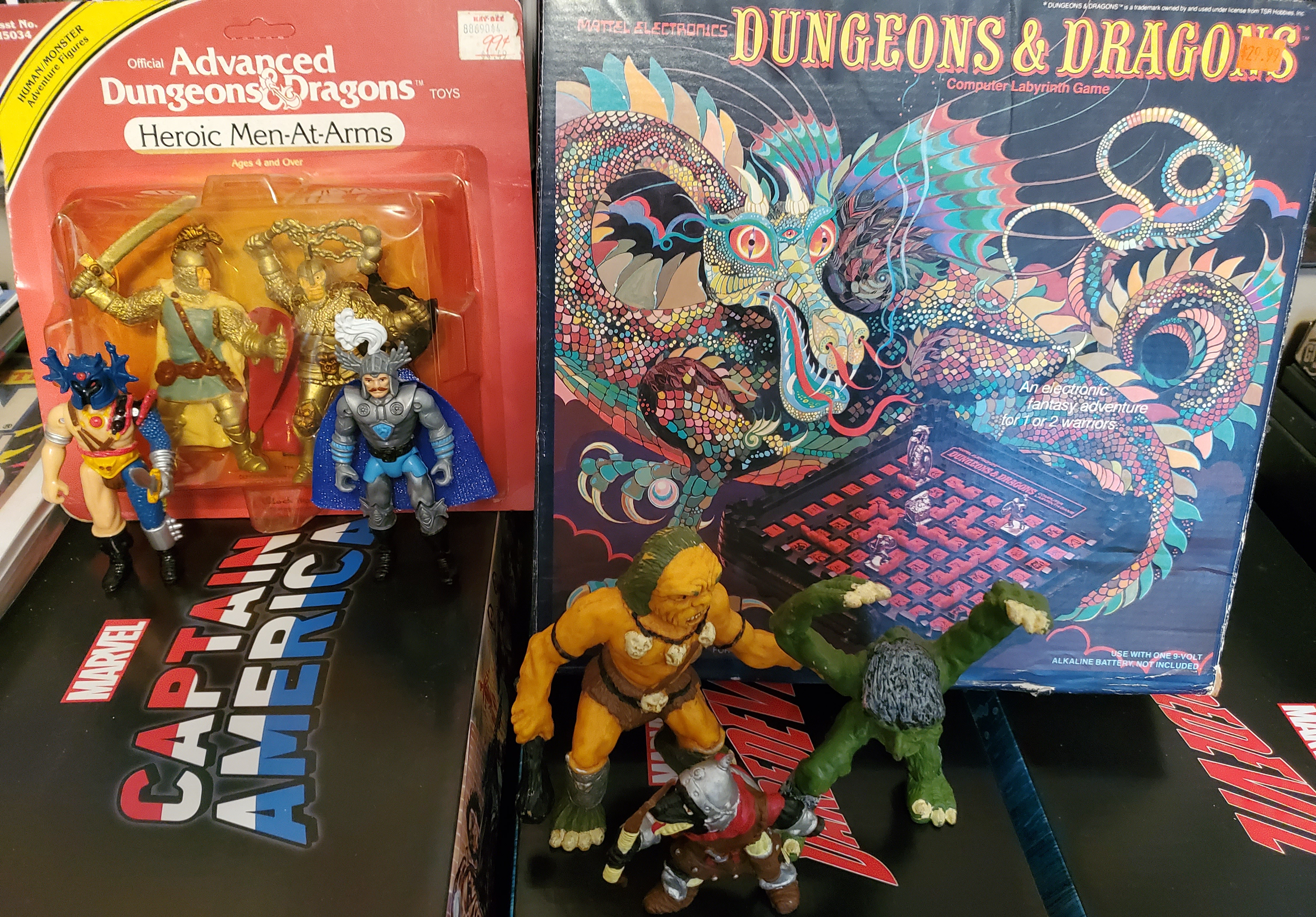
Found a real nice complete Dungeon board game that even came with 2 d6 mud dice, X3, and a Wendy Carlos classical synth record. Also found this beauty in the wild, didn't have the cash on me however.

Outdoor Survival- Quick Review After a Few Run-Throughs
I set up the Outdoor Survival and read through the rules and played out a few scenarios. At a first glance, it’s pretty much a random simulation of how to perish in the wilderness. There aren't a lot of strategy options, at least in the first few scenarios. It looks great, the map is amazing and the counters and cards are sharp, of course the main allure of this game is it’s connection to OD&D which makes it highly sought, but still reasonably findable on Ebay, I believe. The loss of movement due to lowered food/water levels coupled with a randomized movement mechanic makes it so that your chit very quickly finds itself in difficult terrain with no way out before dying of thirst. There is also a random encounter optional rule that makes resources sap even quicker statistically. I certainly would give it a few more go-throughs, and it’s definitely worth owning and showing to other OD&D heads, but without tweaking the rules there’s little chance of completing the scenarios, although I have yet to try scenarios 4 and 5. It was still fun, the turn sequence is super quick and the games play out (to almost always certain death) quickly. I did have one chit that got super lucky and never got turned around from random movement who was able to survive Scenario 2. I have also used this map to run a little OD&D and that was definitely fun and made picking this game up well worth it.
By Boldvay
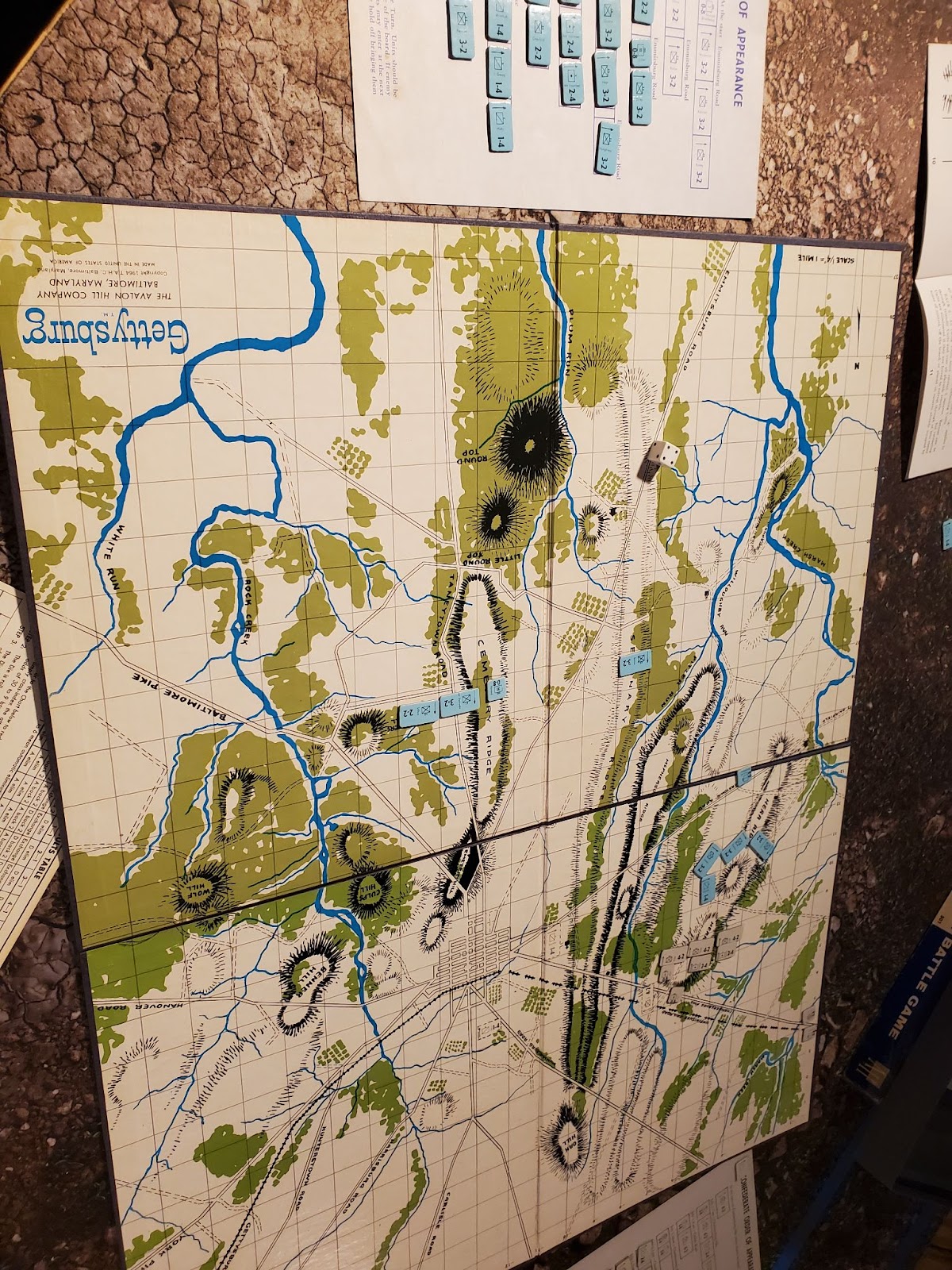
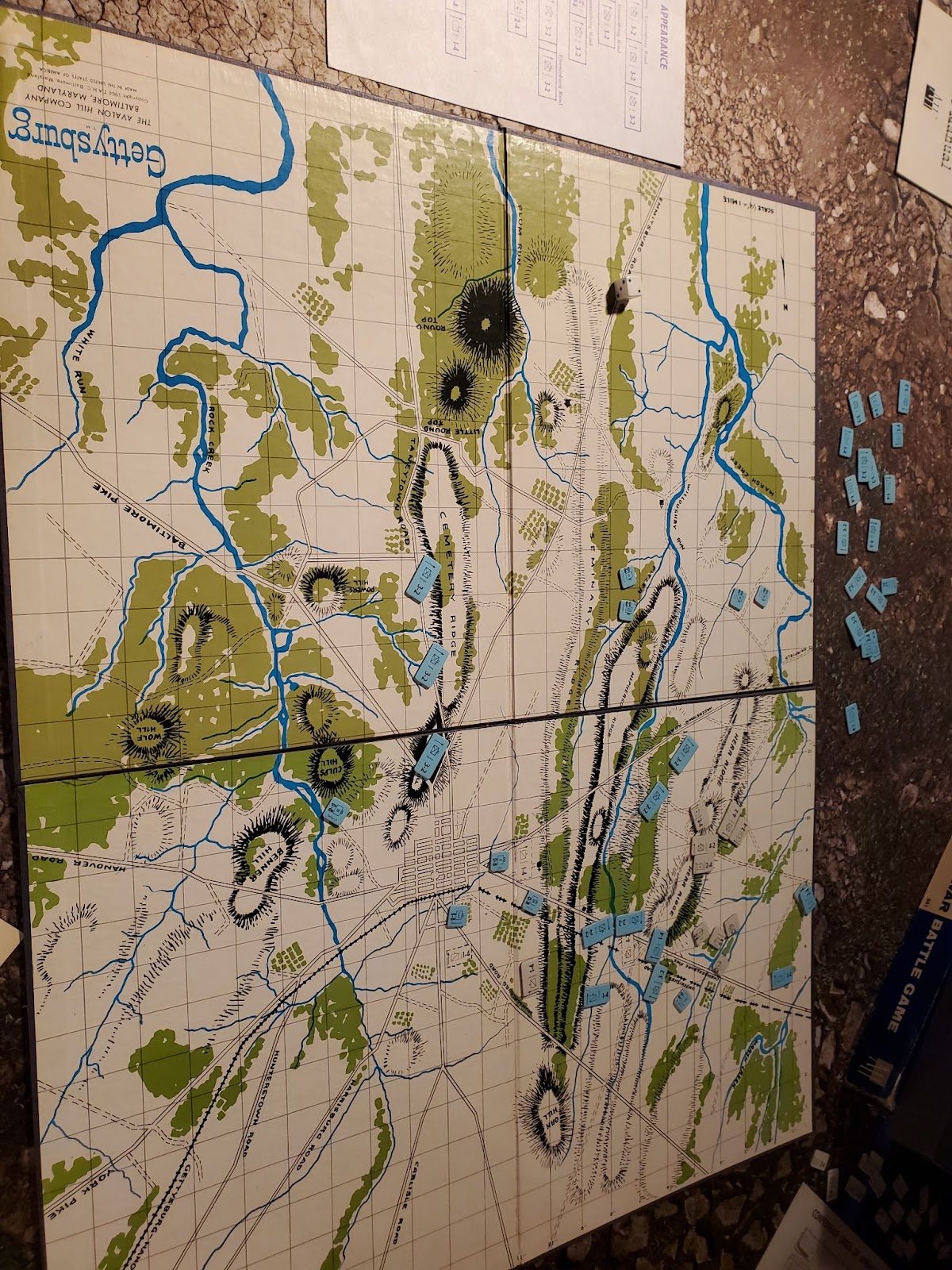
Gettysburg- 1964 from Avalon Hill
This is the first in a possible series of game reviews and adjacent topics with the intent to examine gaming culture of the early to mid-1970s. With an ultimate goal of learning and understanding Original Dungeons and Dragons as it was played at its inception, before it was influenced by the new upcoming release of Advanced Dungeons and Dragons, as well as broader pop cultural influences such as Star Wars. I hope to look at mid 70s board wargaming mostly at games produced by Avalon Hill, but also at miniature wargaming at the time, the great sword and sorcery and science fiction literature of the time, and also the influence of things like chess, Diplomacy, and the early Braunsteins run by Dave Wesley to get a frame of reference as to what a gamers life was like in the mid-70s, and how they would have been informed and prepared to read the 3 little brown books of OD&D and interpret the intended way to play it. But those conversations are for the future, right now I’d like to do a review of Avalon Hill’s 1964 version of the classic Gettysburg.
In looking at some history of Avalon Hill videos, and in reading Jon Peterson’s Playing at the World, this seems a very popular and universally known and played game from the late 60s and early 70s. It was common to see ads in The General, Avalon Hills newsletter, from gamers looking for opponents in their area to play Gettysburg. Gettysburg was among the first releases from Avalon Hill, who basically started the board wargaming movement. Prior to Avalon Hill and its founder Charles Roberts, wargaming was of the miniature variety, and required participants to figure out for themselves what ruleset, miniatures, terrain, and board they intend to use. Board wargaming made all of this more accessible by giving players all of the components of wargaming in a convenient box.
Gettysburg from a rules perspective is extremely stripped down, and I can’t help but imagine that there likely were some house rules added and agreed upon by players to sustain interest and playability in the game. It has a beautiful retro looking map with lots of terrain features on it and many of the historically known sites from the battle of Gettysburg such as Little Round Top. However, the terrain has almost no effect on the game, roads do not aid movement, crossing rivers does not hinder movement. The only terrain effect is that defending from a hill or ridge in combat doubles the defender's combat value. The other rule that affects combat is the game has facing, you can pivot your units facing at the end of each turn, and attacking a unit's flank or rear can double or triple an attackers combat value. Other than that it is a game of positioning, planning the addition of reinforcements and the time it takes them to get to the battle, as you play out the order of battle over the 3 days of Gettysburg. There is a standard Combat Results Table or CRT, this table is the crux of most board wargames. You calculate the ratio of odds of attacker vs defender, reference that column on a chart, and a single die roll tells you the results of each combat. You have the added tactic of “soaking off”, or intentionally setting up one of your combats to be at very poor odds, so that the remaining units can fight in such a way that they have very favorable odds. These CRTs always favor the defender, so great planning on the part of the attacker is required to set up combats in such a way that the attacker has a chance of winning the combat.
This is a game that I purchased off of ebay a few months ago, and I clipped the corners on the chits, and set it up a few times, but I found solo play to be impossible. Perhaps with some kind of oracle you could solo play this, but it wasn’t until my wife agreed to play a game with me did it really reveal its tactical fun. I let her pick what side she wanted to play since she was so gracious as to play a stuffy old wargame with me, and she picked the South. I warned her that the South is at a bit of a disadvantage, explained the basic rules and that defending from a hill was a wise play, and she affirmed that she still wanted to play the South and was up for the challenge. The game for the North is basically hold out in the early game as they over time receive a lot more reinforcements, then try to single out parts of their army in advantageous combats. We found that with the South, castling units on ridges and hills and being aggressive early on when the South has their cannons but the North's cannons have not yet arrived are both good plays. Our game did not develop into combat in several sections of the board, the South used the hills in the NW of the board to draw my troops who mainly were coming from the south and east into long marches across the board. We played for about an hour and a half and 24 turns into the game, we both saw the inevitable end of the South as they just did not have enough reinforcements. Despite losing, my wife said if we played again, she would want to play the South again, as she had some new ideas for different strategies.
The game is very historically accurate, you get an order of battle that is the same from the historical record, troops arrive from the correct road that they historically were at, and there are chits in the game representing all of the generals that commanded the different units. However, the HQ chits have no bearing on the game, they do not fight, and have no zones of control. At one point in the game some of the HQ chits were kind of in the way on the board, blocking the best paths into combat, and we wondered if that was the intent of the pieces, but no it clearly states in the rules that they have no effect on the game. There are certainly areas where some simple house rules could enhance gameplay such as more terrain effects, and doing something useful with HQ units. I have seen in other iterations of the rules that HQ units can defend only and they defend on a 1, so it is possible that there are some minor rules changes in other versions of the 1964 release. This game was redone several times, once in the late 70s, and again in the 80s, and from what I’ve read both of these updates are vastly different games with a lot more complexity than the1964 version, so take note if you are in the market for this game.
Finally got everything set up in the comic collection room. Got a nice L shaped couch in there for reading too.


Scored another box of Grenadier AD&D minis, speed painted 5 with contrast paint. Box is in good shape, minis were terribly painted with acrylics.


So I tried out Jeffro's Battletech/Tunnels and Trolls mash-up today, I was quite pleased. I was serendipitously intrigued when I had both read the article that chronicled the early games and design ( https://jeffro.wordpress.com/2023/09/09/mecha-in-tunnels-trolls/ ), and picked up a copy of Battletech 4th ed for real real cheap at the Brimfield Antiques Show all in the same week. a thorough reading of the article and referencing the mech stats from the back of the rulebook was enough to make converting things over to T&T, which is another system I have no prior knowledge of. I got a pdf of that (1st ed) for $2, and that was very easy to digest, in all my years of gaming I always just assumed T&T was just too simplistic and really just for choose your own adventure type solo games. the combat and saves mechanics are really all you're using so I found 1st ed to be a fine version to use though it seems 4th ed is the preferred version. It took me about an hour of understanding the ranges and combat numbers, the movements bands and activations. I very much like it for quick solo games or over discord resolutions. I could definitely see this going well over a discord chat and using a die roller in the chat. it also could be used for quick combat resolution in a larger more rpg type game. there's a lot of options I could see people using it for. I really like its simplicity, and ease of making adjustments. I allowed my teams to have 4 points they could distribute amongst themselves to give bonuses to either movement or shooting rolls. I also ruled that Banshee's PPC would reroll 1's on damage to represent it's power.

Harry Harrison- Planet of the Damned 1962
With Harry Harrison’s Planet of the Damned we have the first review of a book not mentioned in Appendix N, but representing the “+” in this series- basically Appendix N adjacent material I’m researching and reading. This is pulpy sci-fi, no fantasy influence here, but I’m very interested in this book because it’s connected to a side project I’m working on- an Escape From New York inspired Braunstein RPG. I’ve always been a huge EFNY fan, and in researching my game idea I found out that this book was a big inspiration for the film. In the book, a heroic winner of a planet wide greatest warrior competition is dispatched to a primitive and dangerous planet that has been accused of having weapons of mass destruction capable of destroying a nearby inhabited planet. He and his crack team of experts have mere days to navigate the dangerous new world, infiltrate its strange peoples and find out if in fact they do have the weapon and if so neutralize it before the planet is bombed to oblivion from orbit. I have not read any Harrison before, I have heard good things about his Stainless Steel Rat series, but this is my first reading, and i must say he pulls off some things that in this day and age may seem tropey and overused, but as this was written in 1962, was probably seen more as an upping in the intensity and tension in pulp sci-fi. The classic “timed mission” that will end in some kind of doomsday event is a theme explored in other genres such as war and action/adventure, andHarrison does it well. The pressure of the short time of the mission, fighting fatigue but needing sleep, and a few tics in the story that shorten the already feverish pace of the story work well and don’t feel hokey. Also, Harrison does a thing seen often in more modern stories- introduce a strong heroic character, then kill off said character early in the story as a way of disjointing the reader, and conveying an extreme sense of danger in their story. Our protagonist is originally the subordinate of this character, the one in charge, the one with the plan, and with his death happening in the first few minutes of landing on the planet, Harrison excellently and concisely brings the reader into the seriousness of the situation. There are some cool sneaky/ infiltration scenes in the book, some great action/ fight scenes, and a great frenetic pace. The chapter lengths are perfect, each a bite sized capsule that leaves you wanting to read the next, and some great descriptions of the desolate Road Warrior like planet and its dangerous hearty people. A great fun ride that at the time likely pushed the envelope on edginess. Must read for EFNY fans, you can definitely see things that influenced John Carpenter.
How to Play D&D Like a Wargame "A s far as I know, this is the most comprehensive and most practical description of BrOSR play in...